

As a student, things are never too complicated. Your parents or guardians are there to take care of monthly bills, pay taxes, shop for groceries, etc. Meanwhile, your only job is to study hard. After all, learning basic life skills takes a back seat in an age where academic excellence is prioritised above everything else.
However, only when you graduate and step into the real world do you realise the importance of such skills. According to a survey conducted by OnePoll on behalf of Experian Boost, approximately 81% of 2000 American grad bsbmgt608 assessment Answers students wish they were taught more basic life skills in college.
What are Basic Skills, and Why are They Important?
Basic skills, also known as life skills, are abilities that you learn or gain through experience, allowing individuals to manage and solve day-to-day problems effectively.
According to WHO, UNICEF and UNESCO, there are 10 vital basic skills all individuals should possess:
- Problem-solving skills
- Critical thinking skills
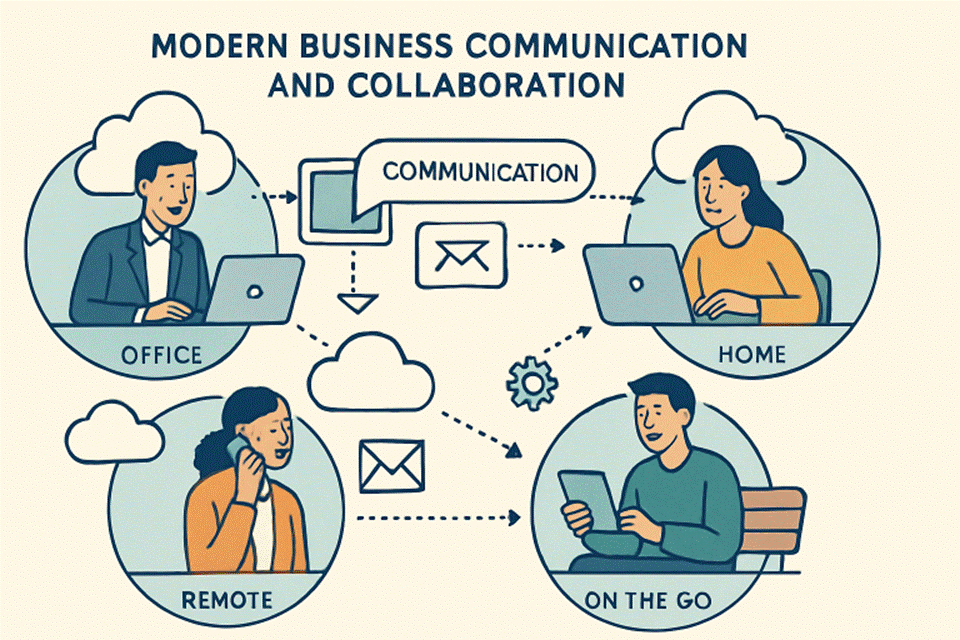
- Effective communication skills
- Decision-making skills
- Creative thinking skills
- Interpersonal relationship skills
- Self-awareness building skills
- Empathy
- Skills to cope with stress
- Skills to cope with emotions
In an ever-changing environment, teaching students these basic skills allows them to:
- Figure out new ways to solve challenges
- Understand the importance of their actions and take responsibility for mistakes
- Analyse unfamiliar situations and navigate through them properly
- Develop self-awareness and appreciation for others
- Build confidence through team activities and collaborations
- Express ideas and opinions more articulately
- Be respectful of other’s opinions
- Be more responsible towards how they act like human beings
- Recognise cultural diversity
Developing such qualities from a young age enables students to tackle all curveballs life throws in their path effectively.
Furthermore, from an employment perspective, several major corporations and powerhouses prioritise candidates with a better grasp of life skills than those with only academic excellence. According to the new McKinsey report, there seems to be an increasing emphasis on social and emotional skills amongst employers compared to 2019.
The sooner students learn to develop these ten skills, the better. That’s why it’s crucial to incorporate activities in schools, colleges and universities that’ll help foster these abilities in students and prepare them to navigate life’s many challenges.
5 Ways to Build Basic Life Skills for Students
In a world where easy access to the internet has negatively impacted human interaction, it is critical for teachers in educational institutions to introduce activities that can develop the basic skills of students.
- Developing emotional recognition
To encourage students to talk about their feelings more openly, you can introduce mimicry activities. First, divide the students into pairs and have one mimic an emotion while the other has to guess the correct answer. Or, you could assign certain emojis randomly to the students and ask them to share stories that prompted them to have a similar expression as the emoji.
However, it is crucial to remember that students with Alexithymia might be incapable of understanding and recognising emotional responses – either of themselves or others. Hence, educators should sensitise parents and peers and have more patience with such students.
- Developing empathy
Empathising with other people is one of the basic skills needed to live harmoniously in society. Since classrooms act as a mini-society with students from all backgrounds and races, empathy exercises can help them recognise and empathise with each other’s situations.
For example, an everyday activity would be to immerse students in a situation that would encourage them to figure out what it feels like to be in another person’s shoes. Showing documentaries of different communities and famous people, you can encourage students to participate in a roleplay where they can pretend to be the characters themselves. Provide them with unique problems and ask them to solve them while being in character. Such activities can help them think outside the box and understand other people’s challenges.
- Developing collaboration skills
Since working together is one of the prerequisites of most companies, students must learn collaboration skills from a young age. Moreover, the entire human society is a collaborative venture where people fulfil their assigned roles and live peacefully. Hence, you’ll face immense challenges in your work and personal life without adequate collaborative skills.
Therefore, teachers can encourage the development of collaborative skills through several activities. For example, you can divide students into groups of four or five and assign each a task for a grand project. Furthermore, they’ll have to work with other groups to ensure the ultimate project goals are reached. This activity allows them to develop their collaborative skills while working in smaller groups and as part of a more extensive system.
- Developing the belief that being wrong is okay
Students have an inherent fear of being wrong and embarrassing themselves in class. This fear never goes away, and once they reach adulthood, several students would rather lie and find excuses than admit they were wrong. However, this can sour personal and professional relationships and become a hurdle to living in peace.
Hence, teachers must encourage a judgemental-free classroom where being wrong isn’t a source of shame. Instead, it is seen as an opportunity for rectification, growth and development. Moreover, students will only feel comfortable asking teachers to clarify doubts when the educator creates a safe environment for such.
- Developing critical thinking abilitie
People have varying opinions on several issues. Therefore, it’s crucial to avoid being swept up in someone else’s views. Instead, you must have the ability to critically assess a situation without any bias and form your own opinion on the matter.
Teachers can encourage the ability to think critically in students by asking open-ended questions, encouraging student-led discussions in class, promote inquiry-based and problem-based learning.
Summing it up,
Developing basic skills from a young age allows you to grow into an exceptional human being. However, as the world gets more complicated with time, students must equip themselves with these skills to solve their day-to-day problems efficiently. While you might not be able to see the effects immediately, following this guide will surely help students polish their basic skills.
Author bio:
Jennifer Hoffer is a professional academic consultant at Myassignmenthelp.com. She provides physics assignment help to students struggling with the pressures of deadlines. Having completed her Master’s in Linguistics, Hoffer aims to pursue her doctorate in the States.