



One of the key advantages that digital banking native businesses have over legacy financial institutions is the technology infrastructure that supports the development and delivery of products and services, contextual personalization throughout the customer journey, and improved experiences and engagement. Supports. To respond to these market advantages, banks and credit unions must rapidly upgrade their marketing technology capabilities to support a more customer-centric approach.
Unfortunately, many banks and credit unions have not responded adequately to fintech companies or alternative big tech providers. Some legacy banking organizations have played defensively with iterative modifications to existing business strategies, while others are confused about what exactly to do.
Interestingly, while the largest financial institutions have the financial capabilities to invest in new technology, many fail to shift from a product-centric approach to customer-centric marketing.
To succeed in the future, financial institutions will need to move beyond their traditional product and service mindset. By leveraging existing customer base and brand strength, banks and credit unions can use data to build a stronger view of customer needs and improve engagement throughout the customer journey.
As branches became unavailable during the pandemic, awareness of digital local alternatives grew, with consumers and small businesses alike “testing the waters” with alternative providers who had developed highly personalized digital solutions. For bank and credit union marketers, the growing reliance on digital banking products and services has led to increased usage and the opportunity for institutions to create better levels of real-time communication and engagement.
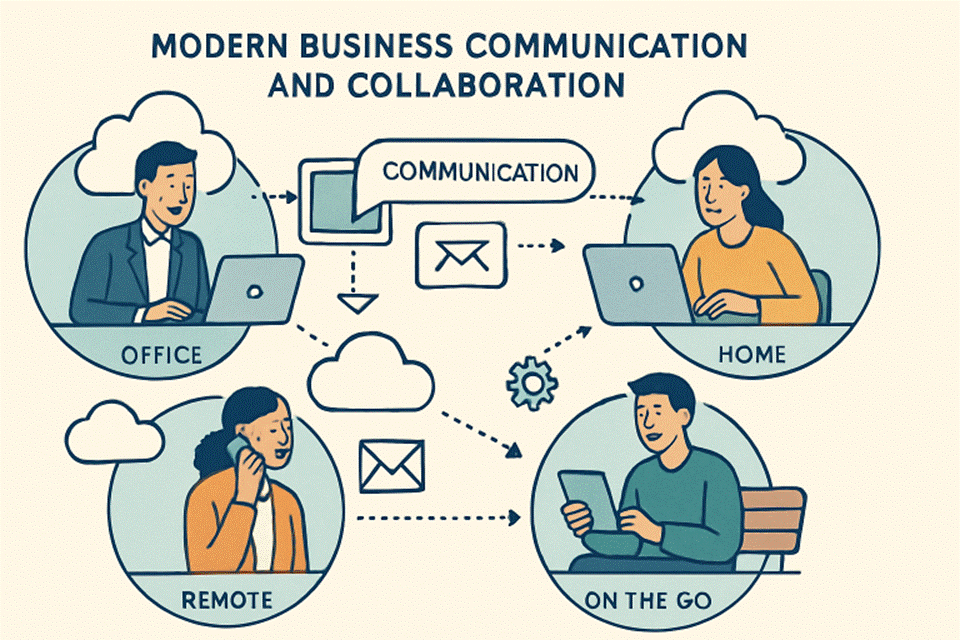
What became even more important during the pandemic was the need for financial institutions to deliver messages seamlessly across multiple channels simultaneously, such as phones, tablets, computers and even smart devices. It has also become more important to create two-way interactions rather than just using push communication.
Finally, the pandemic has forced financial marketers to rethink their business model to deliver hyper-personalized engagement at scale. This requires new marketing technologies that support data collection, analytics, real-time-triggered communication, information democratization, and agile test-and-learn methods.
Marketing Preferences Vary By Provider Type
In response to the opportunities (and challenges) that have developed since the pandemic, financial services providers of all sizes and types are prioritizing investments in marketing technology. According to research conducted by Capgemini for Forrester Consulting, the focus of these investments varied between small financial institutions, large banks and credit unions, and high-tech companies.
Research has found that high-tech companies make customer orientation a more important focus of their marketing strategies than traditional financial institutions. Legacy companies remained highly product-centric in their mindset, organization and marketing strategies. In fact, research has found that only 7 percent of traditional financial services companies will be customer-obsessed in 2021.
Martech Terms Vary By Provider Type
The research also examined the strengths and weaknesses of technology and financial services organizations based on martech maturity across 24 key capabilities across five categories including strategy, process, technology, data and organization. Organizations were grouped into three maturity levels: low (bottom 25%), medium (middle 50%), and high (top 25%). This helped determine a strategic roadmap for each maturity level.
The model showed that large financial services firms were less mature than smaller financial firms and that all legacy banking organizations lagged behind large tech firms in martech maturity. In fact, nearly 40% of legacy financial services organizations self-assessed that their companies were at the level of insanity. Only 14% of technology companies are the least pessimistic. Alternatively, 30% of technology companies were considered to have a high level of martech maturity compared to only 20% of legacy banks and credit unions.
The study shows that financial services companies need to improve around data (information collection, analysis, measurement, and activation and democratization). In addition, traditional financial services companies need more input into their strategies and program execution, moving from product-centric to customer-centric.
Invest In Customer Focus
Modern financial services organizations are investing in data analytics and automation to create personalized experiences throughout the customer journey. They also align their investments in martech to complement and complement their organization’s broader customer initiatives. As res Further research has found that traditional financial firms are less likely to plan resource allocations around future opportunities, and customer It is less likely to collaborate with third-party providers to deliver based innovations.
Modern technology is the biggest obstacle to success and an area of great opportunity for both traditional financial firms and high-tech providers. Legacy technology limits large financial services organizations, making it difficult to keep pace with the capabilities of high-tech companies and digital banking technology native fintech organizations.
Areas Of Improvement And Investment Include:
- Identifying multi-channel customers
- Real-time personalization
- Multichannel measurement of customer engagement
- Modernize the martech stack while eliminating redundancies
- Automate administrative processes for speed and efficiency
- Advanced analytics to improve marketing effectiveness
For more information, please visit friday night funkin unblocked games 911.